Around half of UK adults now get their news from social media. In the United States, the numbers tell a similar story. So what does that mean if you’re running a B2C brand?
It means that when you land a piece of coverage or launch a new campaign, your audience is just as likely to see it on their feed as they are on a publisher’s homepage. Your story has an equal chance of showing up between updates from friends, creators and other brands, and therefore becoming part of a live conversation. And if audience behaviour is anything to go by, social media’s role in shaping how campaigns are discovered and discussed is only becoming more central.
That’s one reason social media has been built into B2C PR campaigns for more than a decade. In this blog, we explore how social media strengthens your PR, the mechanics behind it, which channels B2C brands should prioritise, and what an effective integrated campaign looks like in practice.
Table of contents
Why build social media into B2C PR campaigns?
We don’t have a choice on whether we do social media, the question is how well we do it.
― Erik Qualman, marketeer and author

1. Social media extends the life of your PR
Once a strong campaign hits social media, it can travel far beyond its original placement. A story which starts life on a website can quickly move into group chats, onto timelines and into comment threads. Someone shares it with their own take. Others respond. Before long, it has momentum. And that activity can quickly shape perception.
It also feeds straight back into the media cycle. Ninety-six per cent of journalists use social media as part of their daily work, and many use it to spot stories gaining attention. When a campaign starts to pick up traction online, it becomes more visible to reporters. That visibility can spark further coverage, extending the life of the original PR push.
For consumer brands, this connects directly to the bottom line. People tend to buy from brands they recognise and feel comfortable with. When your brand is being talked about, recommended or even debated in someone’s social feed, it builds familiarity. And familiarity supports consideration and purchase.
Measuring this momentum is also critical to proving meaningful communications outcomes. Reach, shares and engagement show a story travelled and that people interacted with it.
2. Social media improves B2C PR ROI
Beyond the theory and platform stats, there is a clear business case for building social media into your PR campaign. When social is planned alongside earned activity, your coverage stays visible for longer, reaches new audiences and continues to influence consideration and purchase. That extended lifespan is where the commercial value sits, helping you generate more return from the PR investment you are already making.
An integrated PR and social approach delivers:
- More efficient reach from the same PR investment
- Stronger brand familiarity to support consideration and conversion
- Faster feedback to optimise spend and improve campaign efficiency
- Clearer links between communications and commercial outcomes
- Better return on media and content spend
How social media can make your PR work harder
Audience size
One of the biggest advantages of social media for B2C brands is scale. Social media outstripped traditional media in readership in 2016, and the gap has only grown larger. For brands focused on visibility, social media puts your story where large, active audiences are already spending their time.
Volume
Social media gives B2C brands a steady flow of content which keeps them visible even when there is no big news to announce. Unlike media relations, you are not waiting on editorial gatekeepers, and the cost per piece of content is usually much lower than traditional advertising.
Control
With your owned social posts, you have far more control over how your story is told. Unlike earned media, where the journalist shapes the narrative, your own channels let you frame the key messages in a way that supports your positioning and campaign goals. That said, once content is live, the conversation can quickly take on a life of its own, which is why active management and engagement still matter.
Engagement
Social media allows for two-way communication, giving your brand a direct line to your key audience. This is a real advantage when it comes to lead generation, as well as crisis communications and reputation management – where open lines of communication with key parties are vital.
Virality
Social media content has the potential to ‘go viral’, potentially reaching audiences of millions. Aside from TV advertising on major networks, a viral post is perhaps the largest amount of visibility that a brand can achieve.
Influencers
Influencers can be a powerful part of the social mix. While they often require investment, the right creators can extend your reach and build trust with the audiences you want to influence. Research shows that 69% of consumers say they trust influencer recommendations, which is why they continue to play an important role for many brands.
Putting this knowledge into practice
Making social media work for your PR takes a clear plan and consistent execution. It means knowing where your audience spends time, what kind of content resonates there and how you can use that information to shape your campaign for each platform.
The social media landscape in 2026
Should you be on X these days? Does anyone still use Facebook? Is TikTok ‘too hip’?
It’s a complex landscape and one no brand should be expected to navigate alone, never mind have the resources to strategise and execute effectively. The key to making a social media content strategy deliver real impact for PR is knowing how each platform works and who it reaches.
That is an area where Sapience is well-placed to help.
Where B2C brands should focus
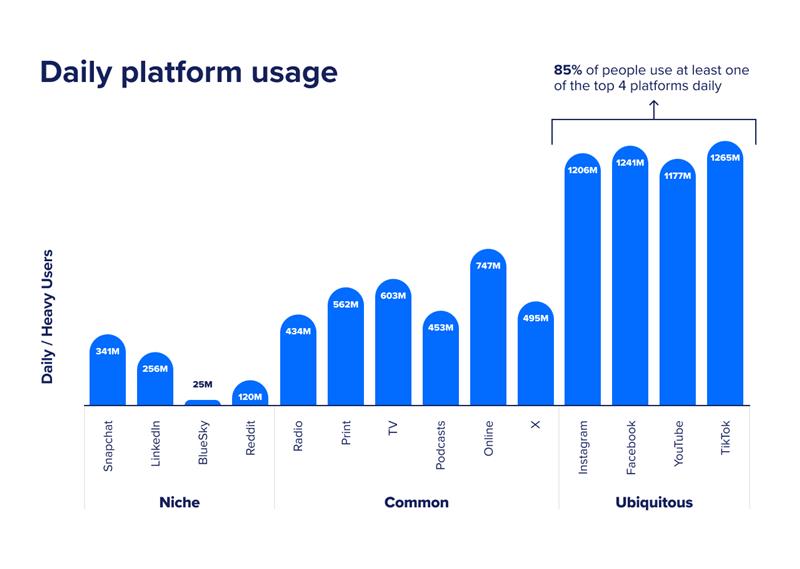
TikTok, Instagram, Facebook and YouTube are typically the best places for B2C campaigns – as these platforms have a more general audience. For B2B-focused campaigns LinkedIn is where you’ll find a more professional user base.

Once that B2B or B2C distinction is made, one of the most common mistakes brands make is showing up on a platform where they think their audience is, rather than where the data shows they are. Social listening and audience analysis tools can help build a picture of where an audience is most active and what content they are most likely to engage with. Audience behaviour varies by sector, demographic and market, and what works for one brand can miss the mark for another. When Sapience work with you on a social media integrated PR campaign, we take time to understand this information, and design campaigns with them in mind.
If your goal is to build awareness at scale, TikTok, Facebook, Instagram and YouTube can be a helpful part of the mix for B2C brands. A striking 85% of people use at least one of these platforms every day making them near-unavoidable touchpoints for today’s consumers.
However, simply having a presence on these platforms is not the differentiator. Each plays a distinct role, attracts different audiences and rewards different content behaviours. Brands see the strongest returns when they tailor their approach platform by platform, rather than treating social as a single channel.
What to expect from a well-planned social media PR campaign
Effective social media-integrated PR campaigns require the same, if not more, level rigour and forethought as traditional media relations, as they have the added complexity of platform dynamics, audience behaviour and real-time performance data.
For B2C brands, social activity which drives commercial impact usually comes down to how deliberately the programme is planned and managed.
If audiences are spending more of their time on social media, and brands are becoming more time- and resource-stretched, where exactly should your PR teams be focusing their social media efforts?
Based on Sapience’s experience, high-performing social media PR programmes typically include the following:
1. Clear objectives aligned to commercial goals
Whether the focus is visibility, demand or reputation, your objectives should shape everything that follows, from content format to channel mix and measurement. Get this right, and you also give yourself a credible way to prove return on investment.
2. Deep understanding of your audience
Your audience is unique to your brand and their age, gender and income only tell part of the story. The same person behaves differently depending on the moment, their mindset and the pressures they are under. A parent buying on their phone at 10pm has very different priorities from that same person browsing on a Saturday morning. High-performing B2C brands map real situations and use cases, not just static audience profiles. The strongest campaigns are grounded in these insights, ensuring content, tone and channel choices reflect how people actually behave in the real world.
3. Operating on the right platform
We’ve already touched on this, but rather than trying to be everywhere at once, focus on the platforms where your priority audiences are most active and most receptive. Often different platforms will play different roles within the same campaign.
4. Strong, consistent messaging
A clear, consistent narrative still sits very much at the heart of effective PR. On social media, where attention is fragmented and content volumes are high, it’s even more important. Executing those messages matters too. Character counts, the opening lines which appear above the fold and the strength of your call to action all play a role in whether content is noticed and acted on.
5. Content built to stand out in feeds
Audiences are exposed to a constant stream of brand content on social media, so how do you expect yours to stand out? It’s all about initiating the scroll stop, as well as quality and relevance. Content which informs, entertains or adds a useful perspective, will get the most reach and engagement. Audiences will quickly scroll past low-effort or overly promotional posts.
6. A mix of formats to support reach
Both algorithms and audiences respond well to a variety of post formats, and the most effective campaigns include video, graphics, imagery and short-form commentary, all of which help increase visibility and engagement.
7. A considered, data-led posting schedule
When your content goes out can have a real impact on its performance. When we design campaigns for B2C brands we take time to understand when your target audiences are most active and most receptive. We test it too, and never rely on convenience-led schedules or assumptions.
8. Continuous performance monitoring
We use a number of analytic tools to dig into our clients’ performance data. We actively track who is engaging, what is resonating and where we can optimise. At the end of a campaign we report our findings and how social media has contributed to the overall success of the PR campaign.
9. Ongoing optimisation while campaigns are live
One of social media’s biggest advantages is the ability to adapt in real time. Performance monitoring allows activity to be continuously reviewed and refined based on live signals. This means campaigns can pivot and improve engagement and media efficiency while they are still live.
10. Active community management and response
Social media is meant to be a two-way conversation not a broadcast. Your social media and PR activity should be monitored and responded to promptly as this helps build trust and deeper engagement. This becomes even more important during sensitive moments or potential reputation risks.
The Sapience approach to social media
As a leading PR agency based in London, Sapience Communications has worked with clients across sectors and markets to increase visibility, build brand presence, launch new products and reach the right customers.
Our approach to social media PR combines carefully considered storytelling with a strong focus on data. In today’s busy online environment, it can be difficult for brands to cut through and engage their audiences. High-quality content and storytelling play a central role. Sapience’s team of experienced journalists and content creators bring decades of collective experience in crafting messages which communicate core propositions clearly to the audiences brands want to reach. Our content team supports the creation of creativs, podcasts, livestreams and text-based posts designed to elevate your presence across social platforms.
We also believe a data-led approach is essential. Our social media specialists use a range of metrics and tools to understand how content is performing and who it is reaching. We provide clear quantitative reporting, such as engagement, reach and click-through rates, so you can see how activity is contributing to your overall return on investment.
A well-planned social media presence can be highly valuable for brands with active audiences on these platforms. Sapience works to ensure your social and PR activity is delivering the impact it should. Contact us to learn more about how we can help your B2C brand.
Get in touch with us to discuss your social media marketing needs
Let’s discuss
You may also be interested in the following articles